Prayer Guidance in Improving Spiritual Intelligence in Children with Physical Impairment
Abstract
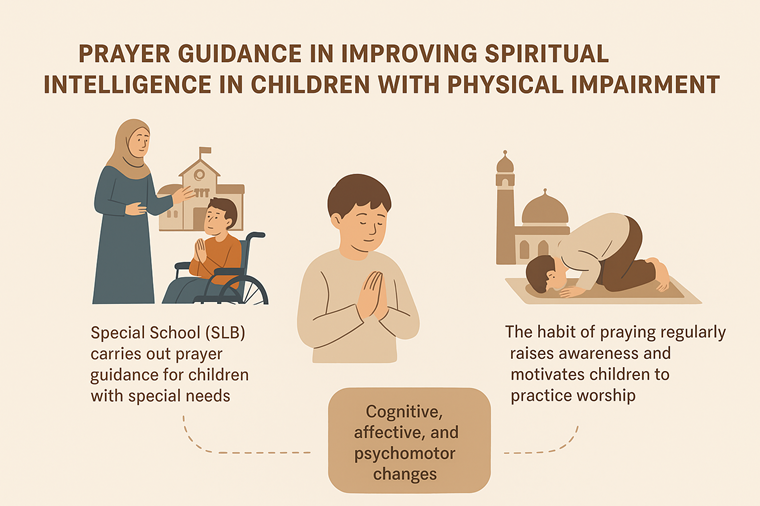
Prayer is one of the main pillars of Islam and even serves as an identity for Muslims and their civilization. Prayer and the mosque as a place of prayer are the two leading institutions in Islam. The command to pray is obligatory for every Muslim who has reached the age of puberty, both in normal conditions and with special needs, such as even a child with a person with quadriplegia. The Special School (SLB) is one of the schools that carries out prayer guidance for children with special needs. The spiritual condition of disabled children in SLB has decreased, one of which is due to their neglect in praying. So, with this prayer, guidance is needed to improve the spiritual intelligence of children with physical impairments. The fact is that the habit of praying regularly at school and at home can raise children's awareness and motivate them to practice worship. This study aims to determine the concept of prayer guidance, prayer guidance techniques, and the results of prayer guidance in increasing spiritual intelligence in children with physical disabilities at Cileunyi State SLB, Bandung Regency. This study uses a qualitative method. The results of the study show that the concept of prayer guidance carried out there includes preparation before prayer, namely ablution, covering the genitals, determining the place and direction of prayer, and performing the prayer standing and sitting. The prayer guidance technique applied is through repetition and habituation, both individually and in groups. The results of prayer guidance show cognitive, affective, and psychomotor changes, namely: the ability to name and distinguish the time and number of prayer cycles, the ability to practice reading and prayer movements, and a change in attitude.
References
Anwar, N. (2021). Efektivitas penerapan bimbingan belajar dalam meningkatkan pemahaman belajar anak pada masa pandemi di Desa Babela Kota. Proceedings UIN Sunan Gunung Djati Bandung, (1), 98–110.
Arifin, I. Z. (2008). Bimbingan dan konseling Islam (Al-Irsyad wa al-Tawjih al-Islam) berbasis ilmu dakwah. Ilmu Dakwah, 4, 27–1092.
Arifin, L. S. (2018). Model dakwah bi al-irsyad untuk pemeliharaan kesehatan mental spiritual pasien di rumah sakit. Ilmu Dakwah, 12, 99–120.
Astati. (2010). Karakteristik dan pendidikan anak tunadaksa dan tunalaras. Bandung, Indonesia: PGSD.
Atmaja. (2019). Pendidikan dan bimbingan anak berkebutuhan khusus. Bandung, Indonesia: PT Remaja Rosdakarya.
Azzet. (2012). Mengembangkan kecerdasan spiritual bagi anak. Yogyakarta, Indonesia: Ar-Ruzz Media.
Basri, H. (2018). Kemampuan kognitif dalam meningkatkan efektivitas pembelajaran ilmu sosial bagi siswa sekolah dasar. Penelitian Pendidikan, 18, 2541–4135.
Habiba, Z. D. (2013). Implementasi salat fardu sebagai sarana pembentuk karakter mahasiswa Universitas Maritim Raja Haji Tanjungpinang. Pendidikan Agama Islam, 11, 153–168.
Hartini, L. (2019). Pendekatan ESQ dalam konseling individual (Telaah pemikiran Ary Ginanjar Agustian). Bengkulu, Indonesia: IAIN Bengkulu.
Hasan. (2008). Panduan salat lengkap dan mudah. Bandung, Indonesia: Pena Ilmu dan Amal.
Ichsan. (2008). Hanya salat khusyuk yang dinilai Allah. Bandung, Indonesia: Mocomedia.
Komaladini, S. (2022). Profil SLB Negeri Cileunyi. Retrieved May 13, 2023, from https://slbncileunyi.sch.id/profiil-slb-negeri-cileunyi-agustus-2022
Lastri. (2019). Pembelajaran ibadah salat terhadap anak berkebutuhan khusus (ABK) di Sekolah Luar Biasa Negeri Kepahiang. Bengkulu, Indonesia: IAIN Bengkulu.
Lela. (2016). Makna dawamul wudhu. Psikologi Islam, 1, 55–65.
Lesmana. (2022). Bimbingan dan konseling belajar. Bandung, Indonesia: Kencana.
M., A. A. (2012). Mengembangkan kecerdasan spiritual bagi anak. Yogyakarta, Indonesia: Ar-Ruzz Media.
Mardhiah, A. (2021). Pengaruh metode penugasan dan pembiasaan terhadap pelaksanaan ibadah salat pada mahasiswa. Intelektual Prodi MPI FTK UIN Ar-Raniry, 10, 108–126.
Maslahah, A. A. (2013). Pentingnya kecerdasan spiritual dalam menangani perilaku menyimpang. Bimbingan dan Konseling Islam, 4, 1–14.
Muhtar. (2016). Aku ABK, aku bisa salat. Bandung, Indonesia: PT Gramedia Pustaka.
Mulyasa, E. (2007). Guru dalam implementasi Kurikulum 2013. Bandung, Indonesia: PT Remaja Rosdakarya.
Naan, A. I. (2019). Bimbingan rohani Islam. Bandung, Indonesia: Simbiosa Rekatama Media.
Prayitno. (2018). Dasar-dasar bimbingan dan konseling. Bandung, Indonesia: PT Rineka Cipta.
Rahti. (2019). Efektivitas bimbingan agama melalui salat dalam meningkatkan kecerdasan spiritual (SQ) santri Pondok Pesantren Raudhatusshalihin Aceh Tenggara. [Undergraduate thesis, Universitas Islam Negeri Sumatera Utara Medan].
Rajab, K. (2011). Psikologi ibadah: Memakmurkan kerajaan ilahi di hati manusia. Jakarta, Indonesia: AMZAH.
Risna, D., & Dini, F. (2019). Peranan bimbingan keagamaan dalam meningkatkan kecerdasan spiritual remaja. Bimbingan, Penyuluhan, Konseling, dan Psikoterapi, 7, 249–270.
Samsuar, W. A. (2023). Hubungan keterampilan psikomotorik terhadap hasil belajar kognitif peserta didik. Dedikasi Pendidikan, 7, 147–156.
Sari, R. P. (2021). Bimbingan salat pada anak tunarungu. Bandung, Indonesia: UIN Sunan Gunung Djati Bandung.
Sazali. (2016). Signifikansi ibadah salat dalam pembentukan kesehatan jasmani dan rohani. Ilmu dan Budaya, 40, 5889–5953.
Smart, A. (2010). Anak cacat bukan kiamat: Metode pembelajaran & terapi untuk anak berkebutuhan khusus. Yogyakarta, Indonesia: Katahati.
Tuwidi, E. (2021). Pengembangan analisis tugas mengenai cara pemakaian pembalut bagi anak tunadaksa. Bandung, Indonesia: SLBN Cileunyi.
Utsman, M. M. (2012). Serba 3 dari Nabi Muhammad SAW. Tangerang, Indonesia: Lentera Hati.
Wahid, A. (2013). Dahsyatnya potensi otakmu dengan salat. Surabaya, Indonesia: DIVA Press.
Yuli, Z. M. (2020). Bimbingan akhlak dalam membentuk karakter anak asuh PSAA Rumah Bening Nurani (YABNI) Sumedang. Bimbingan, Penyuluhan, Konseling, dan Psikoterapi Islam, 2, 145–164.

This work is licensed under a Creative Commons Attribution-ShareAlike 4.0 International License.
Copyright
- The Author and each co-authors transfer the copyright and grant the journal right of publication with the work simultaneously licensed under an International Creative Commons Attribution and ShareAlike 4.0 License that allows others to share the work with an acknowledgement of the work's authorship and initial publication in this journal.
- Authors are able to enter into separate, additional contractual arrangements for the non-exclusive distribution of the journal's published version of the work (e.g., post it to an institutional repository or publish it in a book), with an acknowledgement of its initial publication in this journal.
- Authors should sign copyright transfer agreement when they have approved the final proofs sent by ISLAMIC RESEARCH prior the publication.
Author Guarantee
- The Author (Co-authors) guarantees that the Materials are an original work, submitted only to ISLAMIC RESEARCH, and have not been published previously.
- In case the Materials were written jointly with Co-authors, the Author guarantees that he/she has informed them of the terms of this Agreement and obtained their signatures or written permission to singe on their behalf.
- The Author guarantees as well that:
- The Materials do not contain libelous statements.
- The Materials do not infringe on other persons' rights (including without limitation copyrights, patent rights and the trademark right).
- The Materials do not contain facts or instructions that can cause damage or injury to third parties and their publication dose not cause the disclosure of any secret or confidential information
ISLAMIC RESEARCH is Published by Perhimpunan Intelektual Muslim Indonesia, and licensed under a Creative Commons Attribution-ShareAlike 4.0 International License.
Copyright ©2022.