Science in the Whirlwind of Religion and Power
Experience of Islamic & Western Civilization
Abstract
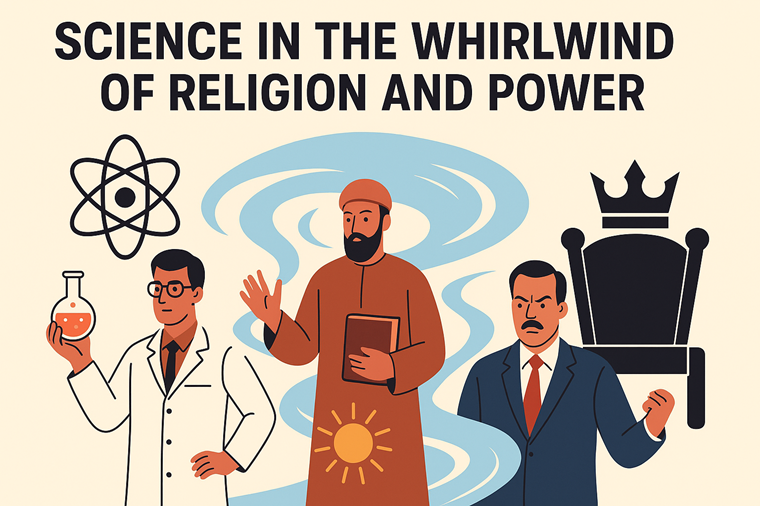
This paper examines the interactions among science, religion, and power across historical and social contexts. Science is defined as a systematic effort to build knowledge through testable explanations and predictions, while religion is a system that connects humans with supernatural and transcendental elements. Power, in this context, is understood as a social production that shapes actors' capacities, actions, and beliefs. The paper outlines a crisis of thinking and literacy among scientists, religious scholars, and politicians, who often fail to understand or disregard the relevance of other fields. Various types of relationships between power and both science and religion are described, including power that protects, suppresses, restricts, utilizes, or mediates between the two domains. Additionally, the paper discusses how religion and science can influence or even conflict with each other. Historical examples of the complex interactions between science, religion, and power are provided, showing that harmony among them can lead to progress, while imbalance can result in regression. In conclusion, Muslims need to understand and appropriately position science, religion, and power to avoid secular extremism and ensure balanced development in society.
References
Barbour, I. G. (1997). Religion and science: Historical and contemporary issues. HarperCollins.
Barnett, M., & Duvall, R. (2005). Power in international politics. Cambridge University Press.
Blackwell, R. J. (1991). Galileo, Bellarmine, and the Bible. University of Notre Dame Press.
Brooke, J. H. (1991). Science and religion: Some historical perspectives. Cambridge University Press.
Brooke, J. H., & Cantor, G. (1998). Reconstructing nature: The engagement of science and religion. Oxford University Press.
Cantor, G., & Swetlitz, M. (Eds.). (2006). Jewish tradition and the challenge of Darwinism. University of Chicago Press.
Cunningham, A., & Grell, O. P. (1993). The four horsemen of the apocalypse: Religion, war, famine, and death in Reformation Europe. Cambridge University Press.
Daston, L., & Galison, P. (2007). Objectivity. Zone Books.
Dixon, T. (2008). Science and religion: A very short introduction. Oxford University Press.
Duhem, P. (1985). Medieval cosmology: Theories of infinity, place, time, void, and the plurality of worlds. University of Chicago Press.
Feldhay, R. (1995). Galileo and the Church: Political inquisition or critical dialogue? Cambridge University Press.
Funkenstein, A. (1986). Theology and the scientific imagination from the Middle Ages to the seventeenth century. Princeton University Press.
Grant, E. (2001). God and reason in the Middle Ages. Cambridge University Press.
Gregory, F. (1986). Scientific materialism in nineteenth-century Germany. D. Reidel Publishing Company.
Habermas, J. (2006). Religion in the public sphere. European Journal of Philosophy, 14(1), 1–25. https://doi.org/10.1111/j.1468-0378.2006.00241.x
Harrison, P. (2010). The territories of science and religion. University of Chicago Press.
Knight, D. (2013). Science and spirituality: The volatile connection. Routledge.
Larson, E. J. (1997). Summer for the gods: The Scopes trial and America's continuing debate over science and religion. Basic Books.
Lightman, B. (Ed.). (2014). Global Spencerism: The communication and appropriation of a British evolutionary theory. Brill.
Lindberg, D. C., & Numbers, R. L. (Eds.). (1986). God and nature: Historical essays on the encounter between Christianity and science. University of California Press.
Merriam-Webster. (n.d.). Merriam-Webster online dictionary. https://www.merriam-webster.com
Mendieta, E., & VanAntwerpen, J. (Eds.). (2011). The power of religion in the public sphere. Columbia University Press.
Noll, M. A. (1994). The scandal of the evangelical mind. Wm. B. Eerdmans Publishing Co.
Nongbri, B. (2013). Before religion: A history of a modern concept. Yale University Press.
Numbers, R. L. (2009). Galileo goes to jail and other myths about science and religion. Harvard University Press.
Polkinghorne, J. (1998). Science and theology: An introduction. SPCK Publishing.
Shapin, S. (1996). The scientific revolution. University of Chicago Press.

This work is licensed under a Creative Commons Attribution-ShareAlike 4.0 International License.
Copyright
- The Author and each co-authors transfer the copyright and grant the journal right of publication with the work simultaneously licensed under an International Creative Commons Attribution and ShareAlike 4.0 License that allows others to share the work with an acknowledgement of the work's authorship and initial publication in this journal.
- Authors are able to enter into separate, additional contractual arrangements for the non-exclusive distribution of the journal's published version of the work (e.g., post it to an institutional repository or publish it in a book), with an acknowledgement of its initial publication in this journal.
- Authors should sign copyright transfer agreement when they have approved the final proofs sent by ISLAMIC RESEARCH prior the publication.
Author Guarantee
- The Author (Co-authors) guarantees that the Materials are an original work, submitted only to ISLAMIC RESEARCH, and have not been published previously.
- In case the Materials were written jointly with Co-authors, the Author guarantees that he/she has informed them of the terms of this Agreement and obtained their signatures or written permission to singe on their behalf.
- The Author guarantees as well that:
- The Materials do not contain libelous statements.
- The Materials do not infringe on other persons' rights (including without limitation copyrights, patent rights and the trademark right).
- The Materials do not contain facts or instructions that can cause damage or injury to third parties and their publication dose not cause the disclosure of any secret or confidential information
ISLAMIC RESEARCH is Published by Perhimpunan Intelektual Muslim Indonesia, and licensed under a Creative Commons Attribution-ShareAlike 4.0 International License.
Copyright ©2022.