Copper Tape- Solar Cell-Based Electrical Circuit as STEM Learning Media to Improve Science Literacy and Creative Thinking Skills
Abstract
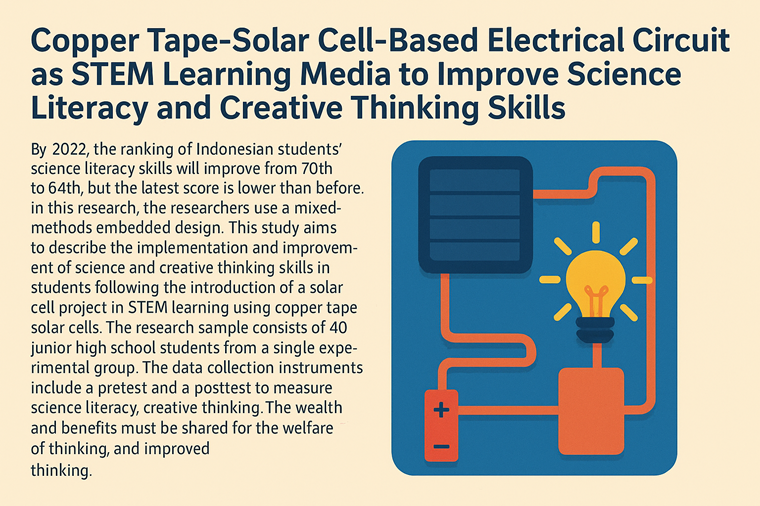
By 2022, the ranking of Indonesian students' science literacy skills will improve from 70th to 64th, but the latest score is lower than before. In this research, the researchers use a mixed-methods embedded design. This study aims to describe the implementation and improvement of science and creative thinking skills in students following the introduction of a solar cell project in STEM learning using copper tape solar cells. The research sample consists of 40 junior high school students from a single experimental group. The data collection instruments include a pretest and a posttest to measure science literacy and creative thinking skills, as well as assessment rubrics to evaluate students' creativity. Implementing STEM copper tape-solar cell learning can improve students' science literacy skills, with an average n-gain of 0.4 in the medium category. Implementing STEM copper tape-solar cell learning can improve students' creative thinking skills, with an average n-gain of 0.5 in the medium category. Based on the MANOVA test, the provision of the STEM copper tape solar cell learning model as a whole can have a significant effect on science literacy, increased science literacy, creative thinking, and improved thinking.
References
Az, M., Rahayu, Y. S., & Rofiq, A. (2023). The Analysis of Umar Masud Junior High School Students’ Science Literacy Ability. Jurnal Penelitian Pendidikan IPA, 9(2), 926–930. https://doi.org/10.29303/jppipa.v9i2.2667
Balakrishnan, B. (2022). Exploring the impact of the design thinking tool among design undergraduates: a study on creative skills and motivation to think creatively. International Journal of Technology and Design Education, 32(3), 1799–1812. https://doi.org/10.1007/s10798-021-09652-y
Creswell, J. W. (2014). Research Design: Qualitative, Quantitative, and Mixed Methods Approaches. Fourth Edition. Sage Publication, Inc.
Daskolia, M., Dimos, A., & Kampylis, P. G. (2012). Secondary teachers’ conceptions of creative thinking within the context of environmental education. International Journal of Environmental and Science Education, 7(2), 269–290.
Deta, U. A., Fahmi, M. N., Nurlailiyah, A., Rusmawati, R., Anggaryani, M., & Jatmiko, B. (2023). Assistance in Making Dynamic Electricity KITs Based on Scientific Argumentation Skills for Physics Teachers in Sidoarjo Senior High School. Bubungan Tinggi: Jurnal Pengabdian Masyarakat, 5(2), 767. https://doi.org/10.20527/btjpm.v5i2.6919
Gasper, B. J., & Gardner, S. M. (2013). Engaging Students in Authentic Microbiology Research in an Introductory Biology Laboratory Course is Correlated with Gains in Student Understanding of the Nature of Authentic Research and Critical Thinking. Journal of Microbiology & Biology Education, 14(1), 25–34. https://doi.org/10.1128/jmbe.v14i1.460
Harikrishnaprabu, V., & Annapooranam, V. J. (2019). Challenges of students in solving physics numerical problems. Young Scientist-Tomorrow's Science Begins Today, 3(1).
Hartono, A., Djulia, E., Hasrudin, H., & Jayanti, U. N. A. D. (2023). Biology Students’ Science Literacy Level. Journal Pendidikan IPA Indonesia. 12(1), 146–152. https://doi.org/10.15294/jpii.v12i1.39941
Harususilo, E. Y. (2018). Rendah di PISA 2018, Nadiem Makarim Siapkan 5 Strategi Ini. https://www.kompas.com/edu/read/2020/04/03/164257471/rendah-di-pisa-2018-nadiem-makarim-siapkan-5-strategi-ini?page=all.
Hermawati, T. (2022). Analysing science teachers’ difficulties in teaching the concept of electricity in junior high school. Research in Physics Education, 1(1), 33–44. https://doi.org/10.31980/ripe.v1i1.22
Madyani, I., Yamtinah, S., Utomo, S. B., & Saputro, S. (2020). Profile of Students’ Creative Thinking Skills in Science Learning. Advances in Social Science, Education and Humanities Research, 397(Icliqe 2019), 957–964.
National Research Council. (2012). A Framework for K-12 Science Education: Practices, Crosscutting Concepts, and Core Ideas. National Academies Press.
Nawanda De Gupita, Alya Rahma Yanti, & Nur Untoro. (2022). Analysis of Students’ Misconceptions in Static and Dynamic Electricity Physics Using the Three-Tier Test. Impulse: Journal of Research and Innovation in Physics Education, 2(2), 119–127. https://doi.org/10.14421/impulse.2022.22.06
Nuryanti, T., Pursitasari, I. D., & Rubini, B. (2023). Science Literacy Profile of Junior High School Students on Climate Change Material. Jurnal Penelitian Pendidikan IPA, 9(11), 9391–9396. https://doi.org/10.29303/jppipa.v9i11.5208
OECD. (2019). PISA 2018 Assessment and Analytical Framework. Paris: OECD Publishing.
Rao, H., Puranam, P., & Singh, J. (2022). Does design thinking training increase creativity? Results from a field experiment with middle-school students. Innovation: Organization and Management, Innovation, 24(2), 315–332. https://doi.org/10.1080/14479338.2021.1897468
Saputri, M., & Syukri, M. (2020). Creative thinking skills profile of junior high school students in science learning. Profile of junior high school students in science learning. Journal of Physics: Conference Series, 1567, 022049. https://doi.org/10.1088/1742-6596/1567/2/022049
Sartika, D., Kalsum, U., & Arsyad, A. A. (2018). Analisis Kemampuan Literasi Sains Mahasiswa Program Studi Pendidikan Fisika Universitas Sulawesi Barat. Wahana Pendidikan Fisika, 3(2), 8–12.
Sujud, R., Rahmawati, Y., & Utami, A. D. (2024). Development of Science Literacy Through Group Choice STEM-PjBL Projects Integrated with Matter State Changes. Jurnal Penelitian Pendidikan IPA, 10(5), 2552–2564. https://doi.org/10.29303/jppipa.v10i5.6441
Tang, T., Vezzani, V., & Eriksson, V. (2020). Developing critical thinking, collective creativity skills, and problem-solving through playful design jams. Thinking Skills and Creativity, 37(March), 100696. https://doi.org/10.1016/j.tsc.2020.100696
Thi, B., & Hang, T. (2024). Developing Creative Thinking in STEM Education through Design- Based Learning Phát triển tư duy sáng tạo trong giáo dục STEM thông qua học tập dựa trên thiết kế. 40(2), 18–30.
Torrance, E. P. (1978). Creativity in the classroom: What research says to the
Teacher. In The Cambridge Handbook of Creativity. NEA (National
Education Association.
Wahyuni, S., Suwarma, I. R., & Hasanah, L. (2024). Feasibility of Integrating Self-regulated Learning in Physics-STEM Module to Train Creative Thinking Skills. KnE Social Sciences, 2024, 209–218. https://doi.org/10.18502/kss.v9i13.15921
Weinerman, J., & Kenner, C. (2016). Boredom: That Which Shall Not Be Named. Journal of Developmental Education, 40(1), 18–23.
Yusmar, F., & Fadilah, R. E. (2023). Analisis Rendahnya Literasi Sains Peserta Didik Indonesia: Hasil Pisa Dan Faktor Penyebab. LENSA (Lentera Sains): Jurnal Pendidikan IPA, 13, 11–19. https://doi.org/10.24929/lensa.v13i1.283

This work is licensed under a Creative Commons Attribution-ShareAlike 4.0 International License.
Copyright
- The Author and each co-authors transfer the copyright and grant the journal right of publication with the work simultaneously licensed under an International Creative Commons Attribution and ShareAlike 4.0 License that allows others to share the work with an acknowledgement of the work's authorship and initial publication in this journal.
- Authors are able to enter into separate, additional contractual arrangements for the non-exclusive distribution of the journal's published version of the work (e.g., post it to an institutional repository or publish it in a book), with an acknowledgement of its initial publication in this journal.
- Authors should sign copyright transfer agreement when they have approved the final proofs sent by ISLAMIC RESEARCH prior the publication.
Author Guarantee
- The Author (Co-authors) guarantees that the Materials are an original work, submitted only to ISLAMIC RESEARCH, and have not been published previously.
- In case the Materials were written jointly with Co-authors, the Author guarantees that he/she has informed them of the terms of this Agreement and obtained their signatures or written permission to singe on their behalf.
- The Author guarantees as well that:
- The Materials do not contain libelous statements.
- The Materials do not infringe on other persons' rights (including without limitation copyrights, patent rights and the trademark right).
- The Materials do not contain facts or instructions that can cause damage or injury to third parties and their publication dose not cause the disclosure of any secret or confidential information
ISLAMIC RESEARCH is Published by Perhimpunan Intelektual Muslim Indonesia, and licensed under a Creative Commons Attribution-ShareAlike 4.0 International License.
Copyright ©2022.