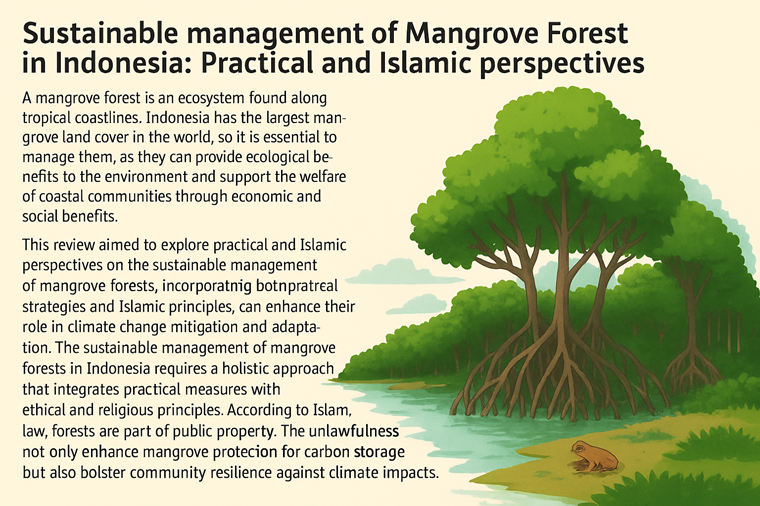
Sustainable management of mangrove forest in Indonesia: Practical and Islamic perspectives
Abstract
A mangrove forest is an ecosystem found along tropical coastlines. Indonesia has the largest mangrove land cover in the world, so it is essential to manage them, as they can provide ecological benefits to the environment and support the welfare of coastal communities through economic and social benefits. This review aimed to explore practical and Islamic perspectives on the sustainable management of mangrove forests. Sustainable management of mangrove forests, incorporating both practical strategies and Islamic principles, can enhance their role in climate change mitigation and adaptation. The sustainable management of mangrove forests in Indonesia requires a holistic approach that integrates practical measures with ethical and religious principles. By combining scientific knowledge, community engagement, and Islamic values, it is possible to create a framework for the sustainable use and preservation of these vital ecosystems. Practically, it highlights the importance of conservation, reforestation, integrated coastal zone management, and community involvement. Islam, as a religion, provides guiding principles and systems that enable problem-solving, including the management of natural resources like mangrove forests. According to Islamic law, forests are part of public property. The state or authority must responsibly manage this public property. The wealth and benefits must be shared for the welfare of the people. On the other hand, it is unlawful to damage and exploit forest resources without careful consideration of the impacts on nature and humans. These strategies not only enhance mangrove protection for carbon storage but also bolster community resilience against climate impacts. This approach not only protects the environment but also enhances the well-being of the communities that depend on mangrove forests for their livelihoods.
References
Arifanti, V. B., Novita, N., Subarno, & Tosiana, A. (2021). Mangrove deforestation and CO₂ emissions in Indonesia. IOP Conference Series: Earth and Environmental Science, 874(1), 1–9. https://doi.org/10.1088/1755-1315/874/1/012006
Arifanti, V. B., Sidik, F., Mulyanto, B., Susilowati, A., Wahyuni, T., Subarno, Yulianti, Y., Yuniarti, N., Aminah, A., Suita, E., Karlina, E., Suharti, S., Pratiwi, Turjaman, M., Hidayat, A., Rachmat, H., Imanuddin, R., Yeny, I.,Darwiati, W., Sari, N., Hakim, S. S., Slamet, W. Y., & Novita, N. (2022). Challenges and strategies for sustainable mangrove management in Indonesia: A review. Forests, 13(5), 695. https://doi.org/10.3390/f13050695
Arvan, A., & Taufieq, N. A. S. (2017). Mangrove forest management for local communities in South Sulawesi, Indonesia. Ecology, Environment and Conservation, 23(1), 77–83.
Aznawi, A. A., Basyuni, M., Hanfiah, D. S., Larekeng, S. H., & Sari, S. P. M. (2024). Impact of pests and diseases on mangrove forest rehabilitation in Indonesia: A review. Online Journal of Biological Sciences, 24(4), 728–738. https://doi.org/10.3844/ojbsci.2024.728.738
Basyuni, M., Hamzah, R. S., & Siregar, U. J. (2012). Pengaruh aktivitas antropogenik terhadap keragaman genetik Rhizophora mucronata Lamk. di hutan mangrove Secanggang Sumatera Utara. Foresta, 1(2), 41–48.
Basyuni, M., Slamet, B., Sulistiyono, N., Munir, E., Vovides, A. G., & Bunting, P. (2021). Physicochemical characteristics, nutrients, and fish production in different types of mangrove forests in North Sumatra and Aceh Provinces of Indonesia. Kuwait Journal of Science, 48(3), 1–14. https://doi.org/10.48129/kjs.v48i3.9160
Basyuni, M., Sasmito, S. D., Analuddin, U., S., T. Z., E., M. F. S., & Milantara, M. (2022). Mangrove biodiversity, conservation, and roles for livelihoods in Indonesia. In Mangrove ecosystems of Asia: Status, challenges and management (Chapter 16, pp. 397–455). Springer Nature Singapore. https://doi.org/10.1007/978-981-19-0519-3_16
Bhagarathi, L. K., & DaSilva, P. N. B. (2024). Impacts and implications of anthropogenic activities on mangrove forests: A review. Magna Scientia Advanced Research and Reviews, 11(1), 40–59. https://doi.org/10.30574/msarr.2024.11.1.0074
Buncag, M. J. J. (2019). Community-based mangrove forest management sustainability: The case of some Asian countries. International Journal of Science and Research, 10(4), 918–926. https://doi.org/10.21275/SR21420102808
Cahyaningsih, A. P., Deanova, A. K., Pristiawati, C. M., Ulumuddin, Y. I., Kusumawati, I., & Setyawan, A. (2022). Review: Causes and impacts of anthropogenic activities on mangrove deforestation and degradation in Indonesia. International Journal of Bonorowo Wetlands, 22(1), 12–22. https://doi.org/10.13057/bonorowo/w120102
Eddy, S., Mulyana, A., Ridho, M. R., & Iskandar, I. (2015). Dampak aktivitas antropogenik terhadap degradasi hutan mangrove di Indonesia. Jurnal Lingkungan dan Pembangunan, 1(3), 240–254.*
Friess, D. A., Thompson, B. S., Brown, B., Amir, A. A., Cameron, C., Koldewey, H. J., Sasmito, S. D., & Sidik, F. (2016). Policy challenges and approaches for the conservation of mangrove forests in Southeast Asia. Conservation Biology, 30(5), 933–949. https://doi.org/10.1111/cobi.12784
Giri, C., Ochieng, E., Tieszen, L. L., Zhu, Z., Singh, A., Loveland, T., Masek, J., & Duke, N. (2010). Status and distribution of mangrove forests worldwide using Earth observation satellite data. Global Ecology and Biogeography, 20(1), 154–159. https://doi.org/10.1111/j.1466-8238.2010.00584.x
Handayani, S., Adrianto, L., Bengen, D. G., Nurjaya, I. W., & Wardiatno, Y. (2020). Pemetaan jasa ekosistem mangrove pada wilayah rehabilitasi di Pesisir Sayung, Kabupaten Demak. Jurnal Ilmu Pertanian Indonesia, 25(4), 574–583. https://doi.org/10.18343/jipi.25.4.574
Harto, S., Sidiq, R. S., & Karneli, O. (2021). Development strategy for mangrove ecotourism based on local wisdom. Sosiohumaniora: Jurnal Ilmu-ilmu Sosial dan Humaniora, 23(1), 115–123. https://doi.org/10.24198/sosiohumaniora.v23i1.31315
Heriyanto, T., Amin, B., Rahimah, I., & Ariani, F. (2020). Analisis biomassa dan cadangan karbon pada ekosistem mangrove di kawasan pantai berpasir Desa Kawal Kabupaten Bintan. Jurnal Manajemen Riset dan Teknologi, 2(1), 31–41. https://doi.org/10.30649/fisheries.v2i2.36
Kusmana, C. (2014). Distribution and current status of mangrove forests in Indonesia. In Mangrove ecosystems of Asia (Chapter 3). Springer. https://doi.org/10.1007/978-1-4614-8582-7_3
Kusmana, C. (2015). Integrated sustainable mangrove forest management. Jurnal Pengelolaan Sumberdaya Alam dan Lingkungan, 5(1), 1–6. https://doi.org/10.19081/jpsl.2015.5.1.1
Oktavia, N., Winarti, S., & Priyanto, A. D. (2022). Pengaruh konsentrasi enzim chitosanase dan waktu inkubasi terhadap karakteristik chitooligosakarida dan aktivitas prebiotik dari cangkang kepiting bakau. Teknologi Pangan: Media Informasi dan Komunikasi Ilmiah Teknologi Pertanian, 13(2), 187–197. https://doi.org/10.35891/tp.v13i2.3080
Rahadian, A., Prasetyo, L. B., Setiawan, Y., & Wikantika, K. (2019). Tinjauan historis data dan informasi luas mangrove Indonesia. Media Konservasi, 24(2), 163–178.
Retni, B., Budiarti, S., Harlis, & Subagyo, A. (2023). Study on the utilization of mangrove forest plants. Journal of Research in Science Education, 9(12), 82–97. https://doi.org/10.29303/jppipa.v9i12.6311
Richards, D. R., & Friess, D. A. (2016). Rates and drivers of mangrove deforestation in Southeast Asia, 2000–2012. Proceedings of the National Academy of Sciences, 113(2), 344–349. https://doi.org/10.1073/pnas.1510272113
Sabri, M. D., Suratman, M. N., & Shari, N. (2021). Management action plans for the development of mangrove forest reserves. In Mangroves: Ecology, Biodiversity and Management (pp. 1–20). Springer. https://doi.org/10.1007/978-981-16-2494-0_20
Samal, P., Srivastava, J., Charles, B., & Singarasubramanian, S. R. (2023). Species distribution models to predict the potential niche shift and priority conservation areas for mangroves (Rhizophora apiculata, R. mucronata) in response to climate and sea level fluctuations along coastal India. Ecological Indicators, 154, 110631. https://doi.org/10.1016/j.ecolind.2023.110631
Sasmito, S. D., Taillardat, P., Clendenning, J. N., Cameron, C., Friess, D. A., Murdiyarso, D., & Hutley, L. B. (2019). Effect of land-use and land-cover change on mangrove blue carbon: A systematic review. Global Change Biology, 25(12), 4291–4302. https://doi.org/10.1111/gcb.14774
Sasmito, S. D., Basyuni, M., Kridalaksana, A., Sasmito, M. F. S., Lovelock, C. E., & Murdiyarso, D. (2023). Challenges and opportunities for achieving Sustainable Development Goals through restoration of Indonesia’s mangroves. Nature Ecology & Evolution, 7(1), 62–70. https://doi.org/10.1038/s41559-022-01926-5
Soegiarto, A. (1984). The mangrove ecosystem in Indonesia: Its problems and management. In H. J. Teas (Ed.), Physiology and management of mangroves (pp. 69–78). W. Junk Publishers.
Sraun, M., Bawole, R., Marwa, J.S., A.S., & Cabuy, R. (2022). Diversity, composition, structure, and canopy cover of mangrove trees in six locations along the Bintuni riverbank, Bintuni Bay, West Papua, Indonesia. Biodiversitas, 23(11), 5835–5843. https://doi.org/10.13057/biodiv/d231137
Sumartini, S., Ratrinia, P. W., & Andini, R. (2021). Pengaruh penambahan maserat daun mangrove (Avicennia marina) sebagai antibakteri pada ikan layang benggol (Decapterus russelli) selama penyimpanan. Aurelia Journal, 2(2), 171. https://doi.org/10.15578/aj.v2i2.9899
Sundra, I. K. (2018). Pengelolaan ekosistem hutan (mangrove) di Nusa Lembongan (Bachelor’s thesis). Universitas Udayana, Denpasar, Indonesia.
Sukwika, T., & Putra, H. (2018). Analisis sedimentasi dan konsentrasi atmosfer pada zona mangrove di Muaragembong, Bekasi. Jurnal Pengembangan Kota, 6(2), 186–195. https://doi.org/10.14710/jpk.6.2.186-195
Putri, E. P., Putra, B. R. S., & Puteri, A. H. A. (2023). Mangrove forest conservation-based tourism industry development in Indonesia. International Exchange and Innovation Conference on Engineering & Science, 9, 161–167. https://doi.org/10.5109/7157967
Worthington, T. A., Spalding, M., Fatoyinbo, L. E., Bunting, P. J., & Friess, D. (2019). Mangrove restoration potential: A global map highlighting a critical opportunity. University of Cambridge.
Yuliana, E., Hewindati, Y. T., Winata, A., Djatmiko, W. A., & Rahadiati, A. (2019). Diversity and characteristics of mangrove vegetation in Pulau Rimau Protection Forest, Banyuasin District, South Sumatra, Indonesia. Biodiversitas, 20(4), 1251–1221. https://doi.org/10.13057/biodiv/d200438
Zulkarnaini, Ariandi, D., & Syahril. (2019). Strategy for mangrove ecosystem management to combat abrasion: A case study of Teluk Papal Village, Bantan District, Bengkalis Regency, Indonesia. EurAsian Journal of BioSciences, 13(1), 75–82.
Zuraida, I., Yuli, A., & Kusumaningrum, I. (2020). Pemanfaatan buah mangrove Sonneratia sp. sebagai bahan baku sirup di Desa Tani Baru Kabupaten Kutai Kartanegara. Jurnal Masyarakat Mandiri, 4(5), 3–10. http://journal.ummat.ac.id/index.php/jmm/article/view/2975

This work is licensed under a Creative Commons Attribution-ShareAlike 4.0 International License.
Copyright
- The Author and each co-authors transfer the copyright and grant the journal right of publication with the work simultaneously licensed under an International Creative Commons Attribution and ShareAlike 4.0 License that allows others to share the work with an acknowledgement of the work's authorship and initial publication in this journal.
- Authors are able to enter into separate, additional contractual arrangements for the non-exclusive distribution of the journal's published version of the work (e.g., post it to an institutional repository or publish it in a book), with an acknowledgement of its initial publication in this journal.
- Authors should sign copyright transfer agreement when they have approved the final proofs sent by ISLAMIC RESEARCH prior the publication.
Author Guarantee
- The Author (Co-authors) guarantees that the Materials are an original work, submitted only to ISLAMIC RESEARCH, and have not been published previously.
- In case the Materials were written jointly with Co-authors, the Author guarantees that he/she has informed them of the terms of this Agreement and obtained their signatures or written permission to singe on their behalf.
- The Author guarantees as well that:
- The Materials do not contain libelous statements.
- The Materials do not infringe on other persons' rights (including without limitation copyrights, patent rights and the trademark right).
- The Materials do not contain facts or instructions that can cause damage or injury to third parties and their publication dose not cause the disclosure of any secret or confidential information
ISLAMIC RESEARCH is Published by Perhimpunan Intelektual Muslim Indonesia, and licensed under a Creative Commons Attribution-ShareAlike 4.0 International License.
Copyright ©2022.